
Disc issues — there's a non-surgical path.
Bulging or herniated discs are one of the most common pain sources we see — and one of the most successfully treated without surgery. Decompression, adjustments, and focused therapies can take pressure off the disc and let the body do the rest.
- Non-surgicalmost patients avoid surgery
- DecompressionFDA-cleared
- 23+ yrsof expertise
Tap a state. Watch the disc change.
A top-down (axial) view of a single spinal disc and the vertebra around it, with a side-profile (lateral) view of three stacked vertebrae below. Each state shows what's actually happening inside.
A healthy disc.
A healthy spinal disc is a tough outer ring (annulus fibrosus) wrapped around a soft gel core (nucleus pulposus). It absorbs load between vertebrae and gives the spine its flexibility. Everything stays inside its borders.
- Annulus is intact and resilient
- Nucleus stays centered, fully hydrated
- Adjacent nerve roots have full clearance
- Disc height is preserved; segment moves freely
Why discs go bad.
Age & degeneration
Discs lose water content over time, becoming less resilient. Common in 30s and beyond.
Lifting injury
One bad lift can cause a sudden disc bulge or herniation.
Cumulative load
Years of poor posture, prolonged sitting, repetitive motion all add up.
Auto / impact injury
Collisions can cause acute disc damage in cervical and lumbar spine.
Genetics
Some patients are genetically predisposed to earlier disc degeneration.
Smoking & lifestyle
Reduces blood flow to discs and accelerates degeneration.
Decompression-first, regenerative-second.
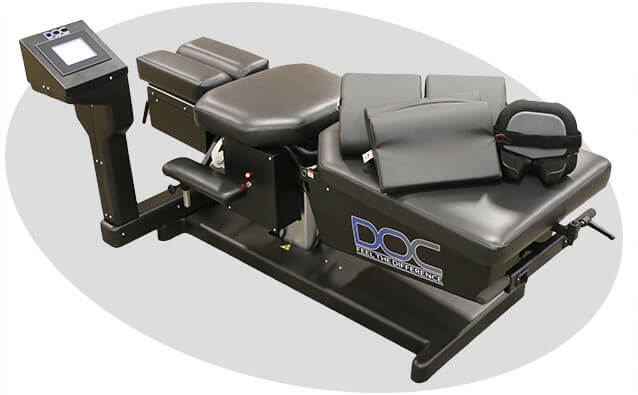
Spinal Decompression
The flagship treatment for disc-related pain. Takes pressure off, supports rehydration.
Learn more →Chiropractic Adjustments
Restore proper movement at adjacent segments so they don't overload.
Learn more →Class IV Laser
Calms inflamed nerve roots and disc tissue.
Learn more →Regenerative Medicine
For severe disc cases not responding to conservative care.
Learn more →Quick answers.
Will I need surgery?
Most disc cases — even severe ones — can be supported successfully without surgery. Surgery is reserved for progressive neurological deficit (severe weakness, loss of bladder/bowel control). Conservative care should typically be tried first.
Can a disc heal on its own?
Yes — many bulges and small herniations resolve over weeks to months when pressure is removed. Decompression accelerates this by creating the negative pressure that helps the body re-absorb material.
How long does recovery take?
It varies. Acute bulges may improve in 6–12 weeks of structured care. More severe or chronic cases need longer plans. Re-evaluations track progress every few weeks.
Can I bring my MRI?
Yes — please do. We review imaging directly with you and explain what we see. If you have a disc on a portal, just bring login info or ask us to request it.
Bulging vs. herniated disc — and what recovery looks like.
A clearer picture of what's happening in the spine helps you make better decisions about disc issues — and avoid surgery you may not need.
Bulging disc vs. herniated disc — what's the difference?
The terms get used interchangeably in everyday conversation, but radiologists draw a clean line between them. A bulging disc is a disc that's protruding past its normal border, but the outer fibrous ring (the annulus fibrosus) is still intact — think of it like an overinflated tire pushing outward. A herniated disc is a step further along: the outer ring has actually torn, and the soft inner material (the nucleus pulposus) has pushed through onto the nerve root. Bulges are extremely common — many adults have them with no symptoms at all. Herniated discs tend to produce sharper, more radiating pain because the inner material is chemically irritating to nerve tissue. Both can be supported with conservative care; both can also resolve over weeks to months when pressure on the disc is reduced and inflammation calms down.
Why most herniated disc cases don't need surgery
Studies suggest that the majority of bulging and herniated disc cases improve with structured conservative care over a span of weeks to several months. The disc itself can re-absorb extruded material as inflammation resolves and pressure is removed. Spinal decompression — the flagship treatment for disc issues at our clinic — uses controlled traction to create negative pressure inside the disc, which may help support rehydration and material retraction. Combined with chiropractic adjustments at adjacent segments (so they don't have to overcompensate), Class IV laser to calm inflamed nerve roots, and lifestyle adjustments, many patients report meaningful relief without injections or surgery. Surgery is generally reserved for progressive neurological deficit — severe motor weakness, foot drop, or bladder/bowel changes — which represent a small minority of cases.
Herniated disc treatment FAQs.
Can a herniated disc heal without surgery?
Yes — many herniated discs improve over weeks to months when pressure on the disc is reduced and inflammation resolves. The body can re-absorb extruded disc material. Decompression, adjustments, and laser therapy are designed to support that process. Surgery is typically reserved for progressive neurological deficit, not pain alone. Learn more about spinal decompression →
What activities should I avoid with a herniated disc?
While the disc is healing, avoid heavy lifting, repeated bending and twisting, prolonged sitting in unsupportive positions, and high-impact activities that load the spine. That doesn't mean strict bed rest — light walking and gentle movement support disc health. We give specific guidance after evaluation, and many patients find that adjusting their daily mechanics matters as much as the in-clinic care.
How long does recovery from a herniated disc take?
It varies. Acute disc bulges may improve substantially over 6-12 weeks of structured care. More severe herniations can take 3-6 months. We re-evaluate progress regularly so the plan adapts. Severe cases not responding to conservative care may benefit from regenerative medicine. For shooting leg pain, see our sciatica page.
Got a disc — let's talk options.
Send us your imaging and tell us your story. We'll be honest about whether decompression fits your case.