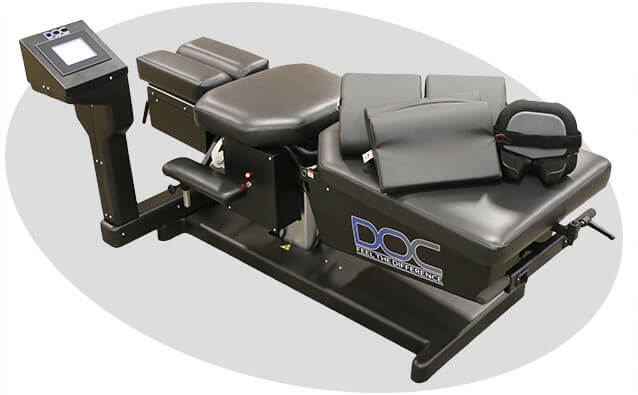
Herniated disc. Sciatica. Low back pain that has not let go in months. Spinal decompression helps a lot of these cases, and it is the wrong tool for some of them. Sorting out which one you are is the whole point of your first visit. At our Lakewood Ranch clinic, Dr. Banman examines you, screens for what rules decompression out, and you feel the table for 15 minutes before you commit to anything. Not everyone with disc pain is a candidate. If you are not, we tell you straight and point you toward what is.
Cash-pay clearHSA/FSA accepted, no insurance games
Feel the stretch
Drag the slider. This is what the table actually does to your disc.
A compressed disc is doing two things at once: pressing down on the nerve below it and starving itself of the fluid exchange it needs to heal. Decompression is designed to break that cycle. The computer-guided DOC-20 table applies precise negative pressure, the upper vertebra lifts a few millimeters, the disc can rehydrate, and the nerve gets the room it has been begging for. Most patients say it feels like a slow, controlled yoga stretch. Drag the slider to see exactly what is happening to the disc.
Pull force
-0 lbs
Compressed-25 lbs-50 lbs
At rest, disc compressed, pressure on the nerve.
Real sessions run 30 minutes per visit, fully passive. You lie down, the table works, you walk out.
The default playbook
Why cortisone, opioids, and surgery are not always the right first answer.
The standard medical pathway for disc pain has not changed much in 30 years. Walk into a primary care office with a herniated L5-S1 and the first prescription is usually a muscle relaxer, the second is an anti-inflammatory, the third is a referral for a cortisone injection, and if those do not hold, the conversation turns to surgery. We are not against any of those tools when a case calls for them. We are against using them by default before the underlying mechanical problem has ever been addressed.
Cortisone calms the inflammation around the nerve. It does not put the disc back where it belongs. Opioids dull the brain's read of the pain signal. They do not heal the tissue. Spinal fusion permanently locks two vertebrae together, and the level above and below carries the load from that point forward. Each of those interventions has a place. None of them rebuilds the disc.
Spinal decompression works further upstream. It treats the mechanical compression itself, the actual reason the nerve is irritated, by giving the disc the room and the fluid exchange it needs to recover. For the right candidate, it is a chance to skip the injection cycle entirely, or at minimum to find out whether your spine can heal before you sign a surgical consent. That is the conversation we want to have on Day 1.
What it helps with
The conditions decompression is actually built for.
Decompression is a focused tool, not a cure-all. These are the six clinical pictures it fits best. If your case is on this list, you are likely a candidate.
Mayo Clinic-affiliated research, peer-reviewed trials, and where decompression actually fits in the standard of care.
Most clinics advertise "proven results" with no citations. Here is the published evidence we point patients to, including the limits of that evidence. You can verify every source linked below.
MAYO CLINIC RESEARCHERS
The Leslie et al. study, presented at the American Academy of Pain Management (2007).
A prospective, multicenter Phase II clinical study led by John Leslie, MD of Mayo Clinic evaluated non-surgical spinal decompression on patients with chronic low back pain (herniated, bulging, protruding, degenerative discs, and failed back surgery). After a six-week protocol of 20 sessions, the study documented an 88.9% success rate in pain reduction, with a 50% reduction in pain scores by week two.
Honest caveat: non-randomized study design. The data is encouraging but not definitive proof. Mayo Clinic continues to list spine decompression among its researched procedures.
A single-blinded RCT of 60 patients with lumbar radiculopathy compared 4 weeks of decompression plus routine PT against routine PT alone. The decompression group had significantly greater improvement in pain (VAS), lumbar range of motion, endurance, and functional disability (ODI), all with p < 0.001 and large effect sizes.
Plain English: for nerve-root pain (sciatica) driven by a disc, decompression added to standard PT outperformed standard PT alone, with the difference being statistically large.
Mayo Clinic recommends conservative care first, for 4 to 6 weeks, before surgery is considered.
For symptomatic herniated discs, Mayo Clinic's standard recommendation is a 4 to 6 week trial of conservative care (physical therapy, anti-inflammatory measures, activity modification). Patients with mild to moderate neurologic findings who do not respond to conservative care are considered for elective surgery. Non-surgical decompression sits inside the conservative-care window: a more disc-targeted option than general PT, intended to give the disc a chance to recover before more invasive steps.
Where Spine and Wellness Center Lakewood Ranch fits.
The Spinal Restoration Program delivers computer-guided, FDA-cleared non-surgical decompression on the same multi-week protocol Mayo-affiliated researchers studied. The plan is dialed in after Dr. Banman reviews your MRI or X-ray and matches the session count to your actual disc-level findings, not a fixed package. Decompression sits alongside the supporting therapies the evidence pairs it with: Class IV laser for inflamed nerve roots, intersegmental traction, electrical muscle stimulation, and chiropractic adjustments to hold the gains between sessions. The visit count your case needs (typically between 12 and 36 sessions over six to twelve weeks) is presented on Day 2 after your exam, so the plan matches the imaging, not a brochure.
A multi-modality clinic, not a single-table chiropractor.
Most clinics that advertise spinal decompression have one machine in a back room. That is the whole offer. It works for simple cases. It struggles with anything complicated.
TYPICAL DECOMPRESSION CLINIC
One table. One protocol. Fixed package.
One machine in a back room, no supporting therapies
Standardized protocol regardless of disc level
Fixed package quoted before imaging is reviewed
Tech or assistant runs every session
No imaging review before plan presented
SPINE AND WELLNESS CENTER LWR
Imaging-led, multi-modality, Dr. Mike personally on case.
DOC-20 table plus Class IV laser, shockwave, EMS, red light, regen-med in one clinic
Protocol dialed to your specific disc level (L4-L5, L5-S1, C5-C6)
Plan presented on Day 2, after MRI/X-ray review
Dr. Banman personally on case through discharge
Imaging-first. No imaging, we tell you on the call
23+
Years in practice
Dr. Banman has run disc cases for over two decades and has worked with regenerative protocols since 2013.
2
Languages
The clinic operates in English and Spanish so families across Lakewood Ranch, Bradenton, and Sarasota get the same care without a language barrier.
7
Stacked modalities
Decompression, Class IV laser, shockwave, EMS, red light, intersegmental traction, and regen-med on the same hallway.
1
Doctor on your case
Dr. Mike personally reviews imaging, presents the plan, and stays on your case through discharge. You deal with the doctor, not a rotating staff.
Your first two visits
Day 1 is not a sales pitch. It is a consult and a sample of the table.
The biggest objection we hear: "How do I know decompression is going to do anything before I commit to a program?" The answer is that you do not have to. Day 1 is built to answer that question.
1
DAY 1
Consult, exam, sample session
1.Meet Dr. Banman. He walks through your history, pain pattern, and any imaging you bring.
2.Focused orthopedic and neurologic exam, plus contraindication screening.
3.Complimentary 15-minute sample session on the DOC-20 table at a comfortable starter force, so you feel the exact mechanism before any plan is presented.
The Day-1 consult fee is set by lead source and quoted on the call when you book, so there are no surprises.
2
DAY 2
Report of Findings and plan presentation
1.Dr. Banman walks you through exactly what your imaging and exam show, the diagnosis, and which spinal level is driving the pain.
2.He presents the plan: the program structure, supporting therapies, and the visit cadence that matches your findings.
3.He steps out. Our care coordinator covers payment options, HSA/FSA, and financing privately. You are never pressured to decide in the room.
Important: if Day 1 reveals that decompression is not the right tool for your case, we will tell you and point you elsewhere. That conversation happens more than you would expect, and it is the reason patients refer their families.
The mechanism
How decompression actually works.
A computer-guided traction cycle, run on FDA-cleared equipment, applied to the exact spinal level your imaging points to. Lumbar or cervical. It runs the same way every session, on the exact level your imaging points to.
Imaging-first targeting
Dr. Banman reviews your MRI, X-ray, or referral imaging. The decompression protocol is dialed to your specific disc level (L4-L5, L5-S1, C5-C6, wherever the compression actually is).
Computer-guided DOC-20 table
The table cycles between gentle traction and release at precise, programmable forces. That cycle is what creates negative pressure inside the disc. Passive traction tables cannot do this.
30 minutes, fully passive
You lie down. Soft straps hold the pelvis or cervical attachment. Most patients listen to music or close their eyes. Nothing about the session is forced or painful.
Lumbar or cervical, same table
We treat the low back AND the neck on the same equipment. Cervical decompression for arm pain, numbness, and disc-driven headaches uses the same negative-pressure principle as lumbar.
Common questions
What patients ask before they book.
Does decompression hurt?
No. Most patients describe it as a slow, gentle stretch held over 30 minutes, closer to a yoga pose than a treatment. The force is computer-controlled and stays inside what your body can comfortably handle. If anything is uncomfortable, we adjust on the spot.
How much does a program cost?
Decompression programs are structured in five tiers based on the visit count your case needs (12 to 36 visits). Investment is presented on Day 2 after your exam and imaging review, because the right tier depends on your specific findings. HSA and FSA funds are accepted on the full program. The Day-1 consult fee is set by lead source and quoted on the call when you book.
Will insurance cover it?
Decompression is rarely covered by insurance plans nationally. That is not unique to us, it is the modality. We are transparent about that upfront, accept HSA and FSA, and offer payment options so the program fits a normal monthly budget. See payment options →
How soon will I feel a difference?
Some patients feel a real shift within the first few sessions. Others, especially with longstanding multi-level disc issues, take longer. We do not guarantee a timeline because no honest clinic can. What we do is track progress at scheduled re-exams and adjust the protocol if your case is not responding the way the imaging suggested it would.
Am I a candidate?
Most cases of disc bulge, disc herniation, sciatica, chronic low back pain, cervical disc issues, and spinal stenosis are good candidates. A small number of conditions are contraindications, recent spinal fracture, certain hardware, active cancer in the spine, advanced osteoporosis, pregnancy. Dr. Banman screens for all of these on Day 1, which is one of the reasons the in-person consult matters.
Book a Day-1 consult. Feel the table before you commit to anything.
The fastest path is a quick call. We answer your questions, ask about your imaging, quote the Day-1 consult fee on the spot, and get you booked. Day 1 includes a 15-minute sample decompression session so you experience the table before any program is on the table.